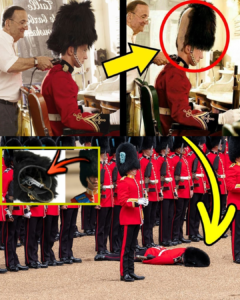
They stand motionless before Buckingham Palace — iconic, immovable, seemingly unshakeable. But beneath the towering bearskin hats and the perfectly pressed tunics, the Queen’s (now King’s) Guard live by a set of rules and realities that are far more extreme than what most visitors imagine. Here are the lesser-known secrets that the Royal Guard would probably prefer remained behind palace gates.
1. Going to the bathroom? Forget it.
Royal Guards are famously forbidden to abandon their posts under any circumstance. And yes — that includes going to the toilet.
A single shift can last up to two hours, sometimes longer during state events, and the rules are brutally clear: do not step away from your position.
So what happens when nature absolutely refuses to wait?
The uncomfortable truth:
They simply let it happen in their uniform. It’s rare, but the protocol is firm — the post comes first, dignity second.
2. The enormous black hat actually has a battlefield purpose
The Guards’ bearskin caps aren’t just for tradition or aesthetic. Historically, they were designed to make soldiers look taller, broader, and more intimidating on the battlefield.
At nearly 45 cm tall and weighing around 1 kg, the hat transforms an ordinary soldier into a formidable presence. The idea dates back to the Napoleonic era, when size and silhouette were psychological weapons just as important as firepower.
3. Six hours of standing — and almost no movement
Each guard typically serves two-hour shifts, and a full day can mean up to six hours of standing with only minimal movement allowed.
Every 10 minutes, they are allowed a tiny concession:
A brief, controlled march of a few steps to maintain circulation and prevent fainting.
Outside of that, no fidgeting, no leaning, no adjusting — and definitely no scratching an itch.
4. Their rifles? Usually loaded with… nothing.
The Guards carry real military rifles with real capability — but on a normal ceremonial day, their weapons contain no live ammunition.
Live rounds are issued only when there is an elevated threat level or official security risk. Otherwise, the rifles are symbolic — a reminder of military tradition rather than active defense.
Still, don’t be fooled:
Every guard is a fully trained British soldier with modern combat training, and they are authorized to shout warnings or take action if needed.
5. The uniform can take them down — literally
During hot summer days, the layer-heavy ceremonial uniform becomes a personal furnace. Combined with long hours of standing, the heat has caused many guards to collapse in spectacular fashion — and there’s a specific protocol for that too.
If they faint, they must fall forward — never backward — to protect the bearskin hat and maintain a soldierly posture.
Their hands must remain on their rifle, even while losing consciousness.
And yes — they must not smile.
A single laugh can result in fines, disciplinary action, or extra duties. That’s why they maintain that tense, stoic expression tourists find so fascinating.
The Silent Strength Behind the Ceremony
They may look like living statues, but the King’s Guard embody some of the most demanding discipline in the military world. Their job is a blend of spectacle, tradition, and unwavering endurance — a performance of loyalty that hides the discomfort beneath.
So the next time you see a guard standing rigid and unsmiling in the London sun, remember:
Behind the unbreakable façade lies a soldier who has mastered the art of suffering silently — all for the sake of history, duty, and one of the most iconic images of the United Kingdom.