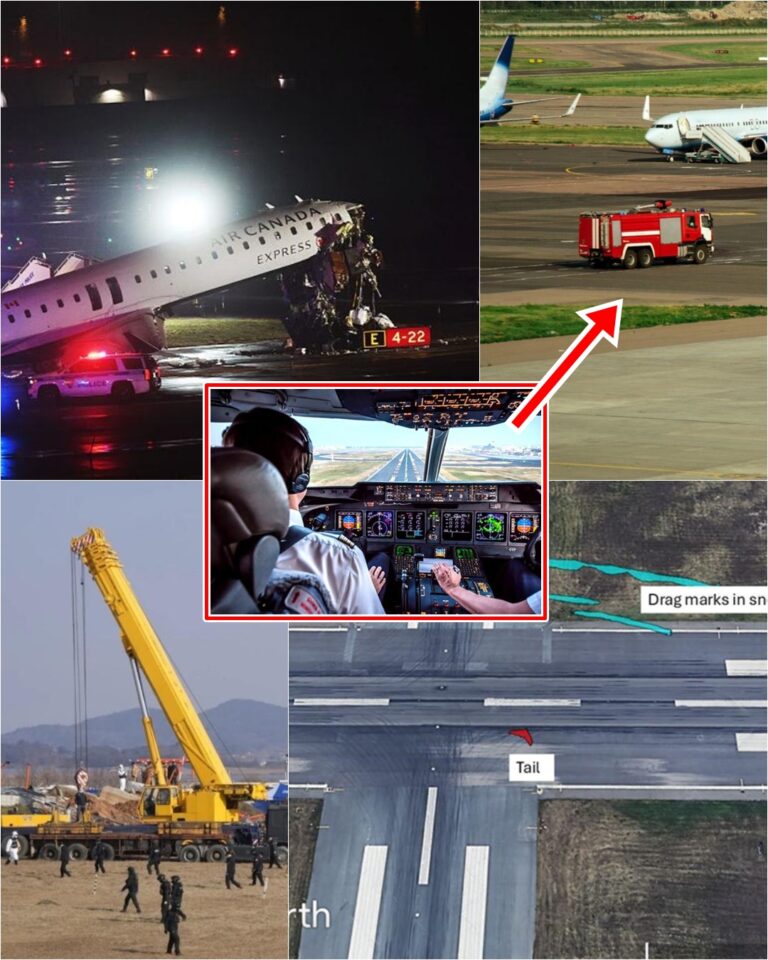
On the night of March 22, 2026, under the steady glow of runway lights and the routine choreography of airport operations, something went wrong—quietly, quickly, and not entirely clearly.
Air Canada Express Flight 8646 was on final approach, descending toward the runway in what should have been a standard landing sequence. Weather conditions, according to early summaries, were not considered extreme. Visibility was described as “operational.” The aircraft aligned, descended, and committed.
Then—impact.
Preliminary accounts suggest the aircraft collided with an airport fire truck that was crossing the runway at the same moment. The vehicle, reportedly responding to a separate situation elsewhere on the airfield, had entered the active runway environment. The exact timing—who was cleared, who was seen, who was heard—remains unclear.
In aviation terms, the event falls under a category that professionals treat with particular caution: runway incursion. It is a phrase that sounds clinical, almost distant. In practice, it describes one of the most dangerous breakdowns in aviation safety—when two active elements occupy the same runway space without full coordination.
And yet, what makes this case linger is not only the classification. It is the presence of something that does not fully align with expectation.
A fire truck—on the runway—at the exact moment of landing.
No official statement has, so far, fully clarified the urgency or nature of the situation that required the vehicle to cross. There are suggestions it may have been responding to another incident. There are also indications that the details of that separate event have not been fully disclosed. Whether this is due to procedural delay, internal review, or something less straightforward has not been publicly confirmed.
What is known is limited.
What is not explained is where attention gathers.
Runway incursions, historically, are rarely caused by a single dramatic failure. More often, they emerge from a chain of smaller misalignments: a misunderstood instruction, a delayed acknowledgment, a missing alert, or a deviation from standard procedure. Each element, on its own, may appear minor. Together, they narrow the margin of safety to almost nothing.
Investigators are expected to examine the role of air traffic control coordination—whether instructions were issued clearly, whether they were received as intended, and whether situational awareness was maintained across all moving parts. Audio recordings, radar tracks, and cockpit data will likely form the backbone of that analysis.
But there is a quieter layer beneath those technical questions.
Why was the vehicle there at that exact moment?
Was its presence fully authorized, precisely timed, and clearly communicated—or was it part of a sequence that did not unfold as expected?
At this stage, no confirmation has been given regarding the full operational context surrounding the fire truck’s movement. Similarly, there has been no definitive statement addressing whether any PRIOR warning systems—visual or auditory—were triggered in time to prevent the convergence.
These are not accusations. They are absences.
And in aviation, absence can be as telling as evidence.
There is also the matter of framing. Early descriptions of the event have been measured, even restrained. Terms like “incident” and “contact” have been used where others might expect stronger language. Whether this reflects uncertainty, caution, or an effort to avoid premature conclusions is difficult to determine.
What remains consistent is the recognition—implicit if not stated—that runway incursions are rarely random. They follow patterns. They expose gaps. They reveal where systems rely not just on technology, but on human synchronization.
Somewhere in that synchronization, something shifted.
The aircraft descended on schedule.
The runway was active.
The vehicle entered.
And for a brief moment, those realities overlapped.
Investigations are ongoing. Data is being reviewed. Statements are being prepared. Each step will, in time, add structure to what currently feels fragmented.
Until then, the night of March 22 sits in a narrow space between explanation and uncertainty—a place where facts exist, but their full meaning has not yet settled.
And on that runway, under controlled lights and controlled voices, a single question remains—quiet, unresolved:
How did two authorized movements arrive at the same point, at the same time, without stopping each other?